Knowledge Base
3D Printing or CNC? Decide on Two Axes: Quantity and Complexity
2026-08-21
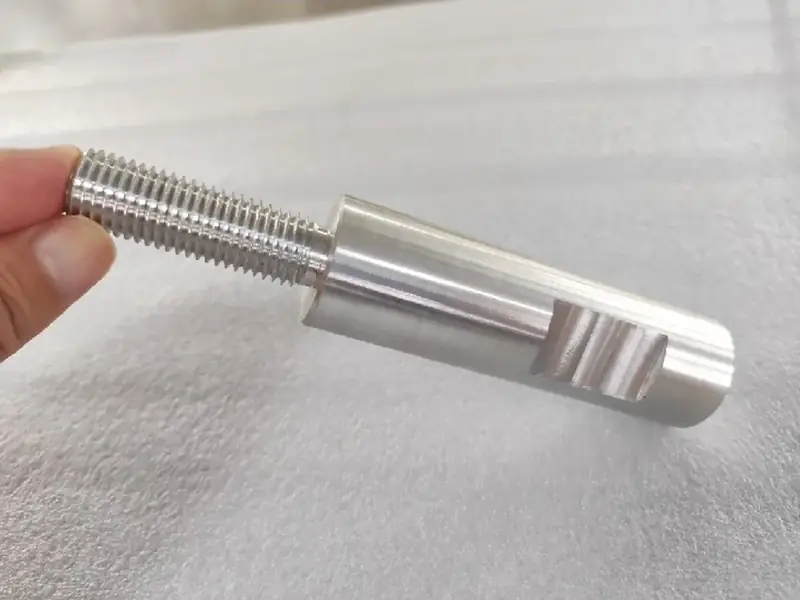
Short answer: the higher the quantity, the more CNC (or moulding) wins; the more complex the geometry, the more printing wins. If you need tolerances tighter than roughly ±0.05 mm, isotropic material properties, or certified wrought material, go CNC. If you need internal channels, lattices, or to consolidate a multi-part assembly into one piece, go printing. They are not substitutes — for many parts the right answer is print first, then finish on CNC.
This is the most frequently asked question and the one most often answered dishonestly — a vendor with one product line naturally argues for that line. We sell and subcontract both, so we can lay the trade-offs out plainly.
Axis One: Quantity Sets the Slope
Printing has almost no setup cost — no tooling, no fixture design, no programming and workholding. So the first part and the fiftieth cost about the same. CNC is the opposite: programming, workholding and tool preparation are one-off investments, painful across one part and nearly irrelevant across five hundred, after which cost per part is mostly machine time and tooling.
The two cost curves therefore cross at some quantity. Where they cross cannot be stated in general; it depends on the geometry — which is the second axis.
Axis Two: Complexity Moves the Crossover
For CNC, complexity converts directly into cost: a feature on another face means another setup (or a 5-axis machine), deep cavities need long-reach tooling and slower feeds, and internal channels simply cannot be milled. The more complex the geometry, the higher the whole CNC curve sits.
For printing, complexity is nearly free — a solid block and a lattice-filled block differ mainly in material consumed (the lattice may use less). This is where printing is genuinely irreplaceable: not "faster and cheaper", but able to produce geometry subtractive processes cannot.
| Dimension | 3D printing (additive) | CNC (subtractive) |
|---|---|---|
| Setup cost | Near zero — no tooling, no programming | High — programming, fixtures, tool prep |
| Cost of part #1 | Low | High |
| Cost of part #500 | Barely decreases | Drops substantially |
| Typical tolerance | Roughly ±0.1 mm class (process dependent) | Down to the ±0.01 mm class |
| Surface finish | Layer lines; usually needs finishing | Usable as machined; mirror achievable |
| Material properties | Anisotropic, strongly parameter dependent | Isotropic — wrought or rolled stock |
| Complex geometry | Nearly free: internal channels, lattices, consolidation | Each additional face means another setup |
| Cannot do | Large high-gloss flats, ultra-tight fitting faces | Enclosed cavities, internal lattices, conformal cooling |
| Material waste | Low — only what is needed plus supports | High — cut away from solid stock |
| Certified materials | Narrower grade choice; request test reports | Mature; aerospace and medical grades available |
Tolerances are common order-of-magnitude references. Achievable tolerance on a specific part depends on process, size, structure and finishing — send the drawing for assessment.
The Most Underrated Answer: Use Both
For many parts the optimum is not either/or. Printing produces geometry subtractive work cannot; CNC brings the mating faces into tolerance. That is exactly the standard route for conformal-cooling mould inserts: SLM grows the cooling channels, then a 5-axis mill finishes the parting line and mating faces. Hybrid additive-subtractive (MUF) machines put both steps in one machine and one setup, eliminating re-datuming error.
- 1–10 parts, complex geometry → printing, almost without exception
- 1–10 parts, simple geometry but tight tolerance → CNC (programming cost buys accuracy; worth it)
- Several hundred and up, simple geometry → CNC; thousands with a mouldable shape → look at moulding or casting
- Enclosed cavities, conformal cooling, lattice lightweighting → only printing can do it, at any quantity
- Complex geometry AND precision mating faces → print then CNC finish, or use a hybrid MUF machine
- Certified materials (aerospace / medical) → confirm the printed grade has the certification; if not, go CNC
Frequently Asked Questions
Can 3D printing match CNC accuracy?
As-printed, generally not at the ±0.01 mm level. But "print then finish" can: leave machining allowance on faces that need tight fits and mill them after printing. This is the standard industrial approach to "complex geometry plus precision fits", not a compromise.
Are printed parts weaker than machined parts?
In the same material, printed parts are usually anisotropic with the interlayer direction as the weak axis, whereas CNC starts from isotropic wrought stock. That does not mean printed parts are insufficiently strong — properly heat-treated metal prints approach forged static strength, and lattice design can cut 30–50% of weight at equivalent stiffness. The key is orienting the print to the actual load path.
Which parts are good candidates for consolidating an assembly?
Functional parts currently built from several components plus fasteners and seals, especially those carrying internal fluid paths — manifolds, pneumatic blocks, cooling blocks. Consolidation removes leak points, assembly labour and BOM lines. Evaluate on total cost, not the single-part price.
At what quantity should I switch to CNC?
There is no universal number, because the crossover is set by geometric complexity: a simple part may favour CNC at a few dozen, while a complex one can still favour printing at several hundred. The reliable method is to send the drawing and have both routes quoted — we run both, so the comparison carries no vested interest.
Related Industry Solution